Monday, 4 August 2014

Variations on a theme, working backwards in time

Fans of classic Warner Brothers cartoons might observe that Isadore "Friz" Freleng was quite fond of re-using gags and story ideas, often transplanting them onto different characters. (See my earlier post on "Curtain Razor") Here is another example, his 1957 cartoon "Bugsy and Mugsy".

Bugsy and Mugsy:


In this short, Bugs is living under the floorboards of bank robbers Rocky and Mugsy's latest hideout. Throughout the cartoon, he tries to convince Rocky that his dim-witted sidekick Mugsy is smarter than he looks, and is trying to kill Rocky and take the stolen loot for himself. As the two crooks beat each other up, Bugs alerts the cops to their presence (which Rocky blames Mugsy for, continuing their fight even in the back of the police car). Why does Bugs do this? Just out of a sense of justice, it would appear. The two gangsters don't actually threaten Bugs in any way - they have no idea he's there - but he feels the need to turn the two criminals in. As they are established as Bad Guys at the beginning we don't seem to mind when Bugs starts playing mind-games on them unprovoked. Well... we don't feel too bad for Rocky. Mugsy is so clueless you've got to feel bad for the befuddled guy, being constantly beaten up for things he hasn't done.

Freleng had already used most of the same plot elements before, in 1950's "Stooge for a Mouse".

Stooge for a Mouse:

Sylvester The Cat - (Ep. 20) - Stooge For A Mouse by cartoonNetworks

This earlier version has an all-animal cast. A mouse takes the role later played by Bugs, with Sylvester the cat in Mugsy's role and a bulldog named Mike in Rocky's. Mike and Sylvester are much friendlier with each other than Rocky and Mugsy would be, and neither is portrayed as being particularly villainous, so I think more audiences would sympathise with them than with the gangsters in the later cartoon. One notable difference is that Sylvester and Mike *are* a threat to the mouse, and so he has more of a personal reason to plot against them. Does his make him more sympathetic, or less so because he appears less selfless than Bugs in the later cartoon? (Notice that in "Stooge for a Mouse", he, not the characters he plots against, is described as a robber) Some audiences may automatically side against Sylvester, recognising him from other cartoons where he comes across as a villain... but Sylvester was often portrayed as a hapless victim or even as a hero in other cartoons, so we can take our pick really.

Well, it doesn't matter who you root for because the end result is that all three characters are knocked unconscious, with an ironic "Home Sweet Home" sign falling behind them. There is less of a straightforward "good guys win through pluck and cunning, bad guys lose through suspicious and violent nature" ending than there would be for the later cartoon.

But this was not the first time this plot was used either. Come upriver with me to Famous Studios. Yes, Famous Studios. That's what they were called. They were the successor to the Fleischer studios which made Popeye cartoons, and they continued to make Popeye cartoons along with Casper the Friendly Ghost and other less well-known characters. One of these characters was Herman the Mouse, who starred in 1946's "Cheese Burglar." Usually he was paired with a cat named Katnip, and their relatively obscure cartoons were actually a bigger influence on The Simpsons' "Itchy and Scratchy" than the more famous Tom and Jerry.

Cheese Burglar:


Well, this is the story Freleng would use for "Stooge for a Mouse", all right. But one story element which didn't survive to either Freleng cartoon was that this cat and dog overhear Herman explaining his scheme to the audience (!), stop fighting, and fool Herman into thinking they've killed each other. They repair their friendship, something that Sylvester-Mike and Rocky-Mugsy would not be allowed to do. In fact, instead of having all three characters punished at the end, they all end up forgetting their quarrels in a state of drunkenness, and singing the same friendship anthem the dog and cat sang at the beginning.

In fact, that's another difference. Not only do this cat and dog manage to become friends again, but they are much more affectionate in general to each other than their later Freleng counterparts would be.

As for Herman, is he more sympathetic than the "Stooge for a Mouse" mouse or Bugs? Less sympathetic? Well, he comes across as more morbid ("The cat's death rattle! Music to my ears!") But... the cat and dog are more of a threat to him, and his need to steal from the fridge comes across as greater than that of Freleng's mouse. Again there is no clear "hero" or "villain", and so, while the makers of this cartoon were kinder on the cat and dog than Freleng would be, as in "Stooge for a Mouse" all three characters end up in the same state.

But this idea has been animated before. The roles of hero and villain are even more clear cut than in "Bugsy and Mugsy", and they are the other way around. Here is Columbia Screen Gems' "Cholly Polly", released 1942.


Cholly Polly:


The parrot fills the role later played by Herman, the nameless mouse, and Bugs. Once again he is trying to break up the friendship between a cat (Myrtle) and a dog (Harold). The difference is, well... the parrot is in no danger from the cat and dog, and he is explicitly depicted as, well, a Nazi. His objection to the cat-dog friendship is because he believes it to be unnatural. Herman and the "Stooge" mouse do tell their respective cat and dog enemies "A cat and dog should be enemies, not friends", but they have an ulterior motive - steal the food once the cat and dog have beaten each other senseless. The parrot does not have anything to gain from making Harold and Myrtle fight. He's just doing it For The Evulz.

As a result, the satisfying ending is that Myrtle and Harold realise that the parrot has been plotting against them and throw him out of the house.

Oh, and if you thought that the "Cheese Burglar" cat and dog were more friendly to each other than their later counterparts, check out Harold and Myrtle. Making them fight is like pulling parrots' teeth. It's only just before the very end that the parrot manages to make them fight... and then they realise that they've been tricked. In fact, this is the only time the two characters are one male and the other female. It's almost as if they are being presented as a married couple. Well, the parrot does object to them "sleeping together" at the beginning? Hmmm, could be.

Of course, during World War II there were a lot of anti-Nazi cartoons. But most of them were simple "We're the good guys, they're the generic bad guys" stories. The villainy of the Nazi character here, the parrot, is more specific. He is repulsed by an inter-species... friendship? Romance? Anyway, it seems like this is a rare example of an anti-Fascist cartoon being specifically anti-racist.

(Incidentally, there is a lot of romantic imagery for the cat and dog in "Cheese Burglar", and the cat's voice is slightly androgynous. But when the "Stooge" mouse accuses Mike the bulldog of being a "sissy" for "liking cats", specifically (the male) Sylvester... No, I'm sure that's not what he means.)

So there you go.
Nazi parrot tries to turn innocent cat and dog friends/couple against each other For the Evulz, and fails
becomes
Sadistic but hungry mouse tries to turn cat and dog BFFs against each other so he can get a bite to eat, succeeds for a while, and they call reconcile and get drunk
becomes
Vaguely hungry mouse tries to turn cat and dog good friends against each other so he can steal some food, succeeds, but ends up beaten up like them
becomes
Smart-aleck rabbit tries to turn wanted criminals against each other in order to see justice served, he succeeds with no ill effects.

I don't know if Freleng was influenced by the "Cheese Burglar", or if the people at Famous Studios were influenced by "Cholly Polly", but the similarities -- and therefore the differences -- are fascinating.

What do other animation fans think? Are there any notable similarities or differences I neglected to mention? Do you agree or disagree with any of my interpretations? Please let me know in the comments!

Monday, 16 June 2014

Hoch Hech!

Is anyone familiar with the Zagreb (Croatia) School of Animation?


I'm sure I've seen that Zagreb Film horse logo before, maybe on a Public Domain video. After which I would presumably have fast-forwarded through the cartoon, expecting there to be a culture and/or language barrier.

I think when most people think of Eastern European animation, they think of this:


From the Simpsons episode "Krusty Gets Kancelled", where kids' TV show host Krusty the Klown shows a cartoon starring "Eastern Europe's favorite cat and mouse team, Worker and Parasite!" The title, gloomy music and settings (a factory and a bread-line) are clearly meant to invoke images of the austere, work-driven Soviet Union at the time of the Cold War, and the joke is that it is neither entertaining nor comprehensible to anyone who doesn't live east of the Iron Curtain in the '50s.

(As a side note, in another Simpsons episode from the same time, "Mr Plow", Homer tries to buy a car from "Crazy Vaclav's Place of Automobiles", and is told that the car was built in a country which "no longer exists". I like to think this was the same country that produced "Worker and Parasite", whose titles are written in a fictional Slavic language. And the head animator of the Rembrandt Films Tom and Jerry series, animated and scored - but not written - in 1960s Czechoslovakia, was named VACLAV Bedrich! Coincidence?)

Soviet-era Eastern Europe may well have produced animated shorts which bring "Worker and Parasite" to mind. But the Zagreb cartoons from the 50s and 60s I have found have, I think, a universal appeal. They are generally dialogue-free but manage to tell stories through animation and music. I don't know if their creators had American animation in mind when they made them - were they trying to copy the style of U.S. cartoons, or react against it, or neither?

This cartoon, "Ersatz/Surogat", has the distinction of winning an Academy Award (an Oscar to you and me). It's very quirky and doesn't look anything like a U.S. cartoon... well, not a mainstream U.S. cartoon anyway. It's still easy for Western audiences to follow and be entertained by it, but putting it out as an example of Croatian animated film making kind of implies "they don't think the way we do".


The same director, Dusan Vukotic, was also capable of creating cartoons that were much more recognisable to people in the West. This one tells a story of childhood rivalry and ingenuity that's familiar to all who have been children, but still exaggerated in a suitably cartoony way. It's a bit like the final act of "Hare Today, Gone Tomorrow", where Buster and Babs fool Elmyra into thinking she's travelled to another planet.


The events from 6:15-6:50 bring to mind the fable of the blind men and the elephant.

Another director, Zlatko Grgic (who previously worked as character designer on Vukotic's cartoons) appears to have had two favourite themes: "No Good Deed Goes Unpunished" and "I Don't Know How To End This Thing". Here's his "Musical Pig". Watch as the poor pig brings happiness to all around him by his singing, and how his refusal to let them eat him anyway (!) causes conflict, strife, and even war!

Oh, and the knife-eating sound effects are painfully convincing!

Friday, 12 July 2013

From Dick... to Duck... to Pluck!

This is the Tiny Toon Adventure short "The Return of Pluck Twacy", part of the episode "New Character Day", one of the last episodes of the original 65-episode run. It was written, 'boarded and directed by Eddie Fitzgerald. The opening few seconds of the video are the end of the first segment of the episode. You can ignore that.


First of all, I'd like to clear up any confusion caused by the multiple Tracy/Twacys:

Dick Tracy is a private detective from a newspaper comic strip.
Duck Twacy is from the 1946 cartoon "The Great Piggy Bank Robbery". In this cartoon Daffy avidly reads a Dick Tracy comic strip, knocks himself unconscious, and dreams about being a Dick Tracy style character named "Duck Twacy."
PLUCK Twacy is from the Tiny Toons episode. It is the character *Plucky* dreams about after hearing a speech by Daffy in his Duck Twacy persona.

All sorted? Good. Why do I think there might be some confusion? Well, the segment is supposedly Daffy/Duck Twacy's audition tape, and yet most of it is about Plucky/Pluck Twacy. Also, at one point on his blog Eddie Fitzgerald said that *Pluck* Twacy was a character from a 1940s cartoon who he brought back for TTA. (although he later deleted that, either when someone else pointed out his mistake or when he realised it)

Finally, there is the title, The *Return* of Pluck Twacy. We have never seen Pluck Twacy before, and never will again. So why The Return, unless someone mistook Pluck Twacy for a character who had already appeared?

Anyway, ignoring these problems (which is easy to do after the first few seconds) this is a pretty fun cartoon. The scenes where Plucky bashes himself over the head in order to cope with the tickling are really funny, and the bit on the neon train (a reference, perhaps, to GPBR's "Neon Noodle") is gloriously imaginative, although some may feel it drags out a little.

Some TTA fans are quite hard on it, including one review (on the Tiny Toons Reference Guide) who says that it "sinks to the level of its inspiration", which sounds like a criticism of the original "Great Piggy Bank Robbery". So, it's probably not one for audiences who are into 90s cartoons but not the ones from the 40s. (well, unless there are actually 40s WB fans who don't like "The Great Piggy Bank Robbery" for some reason)

I can kind of understand the problems some people might have with it. There's nothing particularly distinctive to Tiny Toons about it, except in the opening and closing scenes, set in Acme Looniversity, and the point where Plucky gets the vision of Daffy/Duck Twacy giving him advice (that is, because it follows the TTA theme that these are the fans/disciples of the classic characters). Mostly it's a mash-up of multiple classic Warners cartoons, made by someone who is clearly a fan of them and saw this as a chance to make his own.

Obviously, the main set-up comes from Bob Clampett's "The Great Piggy Bank Robbery". The "aura" character is based on Hata Marie from Frank Tashlin's WW2 era "Plane Daffy", and "Tickle-Puss" is Sloppy Moe from Clampett's "Wagon Heels", who saves the day by tickling the villain into submission. There may also be an influence from Bob McKimson's "The Super Snooper" in the way the aura behaves towards Plucky, but the style is much more influenced by Clampett and Tashlin. The scenes where Plucky is surrounded by criminals with weird names, and he gasps as he lists them, is directly from GPBR, although it had already been given a TTA treatment in "Return of Batduck." (I feel the Batduck version works a little better, as it is more imaginative and unexpected, and making all the criminals parodies of Batman's Rogues Gallery gives it a life of its own. Putting it in a setting more directly influenced by GPBR feels less imagintive and more derivative.)

Some shots even seem to be traced from the original cartoons: the long shots of Plucky surrounded by the weird criminals - who all of a sudden look much more like the GPBR villains than the ones in the rest of this cartoon, and the part where Plucky leaps off the guillotine and faces-off the aura - the helmet which he puts on to protect himself from the blade makes him look even more like Daffy in Plane Daffy.

The animation is by Glen Kennedy's studio, which is probably the best choice for a Clampett/Tashlin influenced cartoon. I'm a lot easier on Kennedy than a lot of people, but their animation here is a lot weaker than on some of their other episodes. The scene where Plucky wakes up on the floor of the classroom is particularly bad looking (and there's a strange mistake, where he is seen writhing around for the first few seconds without anyone surrounding him... is he, like, dreaming that he's waking up in an empty classroom, before he actually wakes up in a full one?) Jon McClenahan of Startoons fame animated the introduction where Babs and Buster audition Daffy, and speech Daffy makes to the class, although the last shot of Daffy with the apple seems to be a different animator. It's a shame there isn't more of him, though. I'm sure that Eddie himself was happy to see it assigned to Kennedy, because as we all know he admires Glen Kennedy's work. But I'm not sure if Glen actually animated anything on this one.

Oh, and the ending takes Daffy's "manic depravity" (John Kricfalusi's description of "The Great Piggy Bank Robbery") to a new level. When Daffy woke up, he found himself kissing a pig in a mud pen, and was disgusted for about a second before whooping around excitedly, no doubt because of how much fun his dream was. But in Plucky's case, he bashes himself over the head with a mallet so he can return to his dream! (watch Daffy's encouraging expression at this point!) Kind of reminds me of a certain cop show that I won't name to avoid spoiling people.

Monday, 8 July 2013

I don't know what to say the monkeys won't do!

Like many people, I'd imagine, the first version of this song I encountered was the one featured in the first episode of Animaniacs.


(if the video is taken down by the time you read this, just do a google search for "Animaniacs Monkey Song" or better yet pop in your Animaniacs Volume 1 DVD!)

But I was pleased to find the original version was also available on YouTube:


Some people might call the Animaniacs version a "parody" of the original, but it isn't really... it's just the Warners and Dr Scratchansniff doing their own version of it. The tune is the same, and most of the lyrics are very close. The instrumental breaks are in the same places (accompanied by scenes of other Animaniacs characters doing their schtick), and some of Belafonte's interjections are repeated by the Hippos. "Play that thing!"

It was a surprise that the Belafonte original has only one monkey causing him grief... I guess we naturally think of monkeys coming in trios? (notice the poses the Warners are doing at 2:27!) They just upped it to three monkeys for the Animaniacs version because there are three Warners.


Verse 1: First two lines very close, original has a repeat of the lines, Animaniacs version has two new lines which are specific to the characters and setting. (in fact, the Animaniacs version avoids line repeats a lot more than the original, with more lines rhyming with "Don't know what to say the monkeys won't do" in the chorus parts.)

Verse 2: This is the most different from the original version. Belafonte has the monkey letting his girlfriend in and pouring her a glass of gin. Scratchandsniff has the Warners doing a dance for the Nurse and pouring biting bugs down his clothes. The only similarity is that the end of the second line ("and what do you think?" vs "and what could be worse?") are quite close.

Also, a common theme in the original is the monkey copying Belafonte's actions: "I do X, monkey does X too." The only time something like this appears in the Animaniacs version is here, and it's the other way around: the Warners make Scratchansniff itchy so *he* copies *them.* "Monkeys dance, then I dance too!"

Verse 3 is almost exactly the same, but with the Nurse in place of Belafonte's girlfriend.

Verse 4: Also very close, but this is where the exaggeration of the original starts. Belafonte's "cabinet" was laid to waste, but Scratchy's entire bathroom is. Belafonte has to shave with toothpaste... but the Warners actively shave Scratchy's *head* with the stuff.

Verse 5 continues this exaggeration. Belafonte brushes his hair with a shoe-brush, the Warners use one to shine Scratchy's (shaved in the previous verse) head. Belafonte "almost" goes down (the toilet, presumably), while Scratchy is not so lucky.

Verse 6 is even closer to the original than verse 3... which is quite easy to believe, as trying to make a stew out of the Warners isn't exactly Scratchy's nature. (He's not an Elmer Fudd type hunter/predator, but more like a long-suffering parent or teacher when we usually see him) New to the Animaniacs version is the ensuing chorus which puts Scratchy in the stew himself.


So, as you can see, most of the lyrical changes were small variations to make the Warners more actively annoying than the original.

Say... if you're interested in more Animaniacs commentary, check out Mike R's incredible in-depth blog Hello, Nice Warners!

Monday, 18 February 2013

Bosko The Minstrel

Those early rubber-hose cartoon characters, with their basic facial designs altered only by the shape of their ears and, occasionally, noses... it can be pretty hard to tell what kind of creature they're supposed to be. Indeed, they made a running joke of it many years later in Animaniacs, where people often wonder what species the Warners are, with their late-20s-early-30s inspired designs.

The Warner Brothers studio's first character, Bosko, fits the usual design pattern - white face, black nose, solid black eyes, and black... hair? covering the rest of his head. But he was apparently meant to be a human character. His ears, the usual species giveaway, look like simplified forms of human ears, compared to the large black things protruding from the tops of Oswald the Lucky Rabbit, Mickey Mouse or Foxy's heads. In fact, he was meant to be a *black* human.

Which seems quite a bizarre claim to make about a white-faced character, but when Harman and Ising took the character to MGM, they made him (and Honey) obviously dark-skinned human characters. I suppose when you think of the stereotyped depictions of black people that were common at the time, Bosko's white face could be seen as comprising large white eyes and large white lips... with the black portion behind his face being his skin.

Certainly, when Bosko and Honey were brought back for an appearance on Tiny Toon Adventures, they were redesigned to have floppy black ears atop their head... making them a more indistinct species like the later Warners on Animaniacs. So, to the people who made that episode at least, there was something controversial about their original appearance.

However, Bosko doesn't really read as a "blackface" caricature. Harman and Ising, and their staff, probably forgot that's what he was meant to be in the first place, or discarded the idea. Take a look at the final gag from this cartoon:


A bomb goes off in Bosko's face, covering it with... bomb dust or whatever, and transforms him *into* a blackface character, announcing "Mammy!" So if he had to be turned into a blackface character, what is he the rest of the time?

Sunday, 3 February 2013

What about everything?

I've decided I should keep this blog for animation-related posts. If you're interested in reading about other things I have to say, visit my livejournal at http://darmok47.livejournal.com/.

Sunday, 16 December 2012

The Lion King opening sequence

A while back, someone sold a Lion King animator draft on eBay. I didn't buy it, but the seller included a few sample pages. I'm assuming it's genuine but someone with access to the studio archives can probably confirm if it's an accurate example of a 90s feature draft.


The sequence director is Rob Minkoff, one of the film's two directors.

There is more information on this draft than on the "golden age" drafts uploaded by Hans Perk, in that it doesn't just include the animator name but also the layout (for individual shots rather than the whole sequence) and background artists, plus something called "CU LO" (clean-up layout?) Unlike some of the earlier drafts, unfortunately, it doesn't identify which animator was responsible for which characters when they shared a scene. But for the most part we can work it out:

Animation of main characters is by Russ Edmonds (Sarabi and Baby Simba), Tony Fucile (Mufasa), Chris Wahl (Mufasa plus a group shot of the whole family and Rafiki), Ellen Woodbury (Zazu), James Baxter and Ron Husband (Rafiki). For the most part these are supervising animators responsible for their characters. Baby Simba is aimated by Sarabi's supervisor rather than one of the "Young Simba" animators listed in the closing credits. Ron Husband (who started out during the twilight years of the Nine Old Men, animating in Frank Thomas' unit in The Rescuers) is listed as a Pumbaa animator but gets a couple of brief shots of Rafiki here. There are a couple of scenes by a "Haidar" but I have no idea who that is. A Google search for the name plus "Lion King" shows the name has some significance to the lion species in myth and legend - whether this is an indication that this is a false draft, with the identification included as an injoke, or whether it was just a happy coincidence, I have no idea.

edit: This is probably Joe Haidar, credited as an animator on other Disney features of around the same time. IMDb says he was an uncredited "character designer" on The Lion King.

Most of the animation of the incidental animals is by people who also worked on major characters. They are animated by Andreas Deja (rhinos, also Scar), Michael Surrey (meerkats, also Timon, appropriately enough), David Burgess (cheetahs, also hyenas), Anthony DeRosa (gazelles, also Adult Nala), Phil Young (topis, also Mufasa), Dave Stephan (storks and flamingoes, credited with "additional animation"), Bob Bryan (elephants, also Adult Nala), Brad Kuha (elephants and guinea fowl, also Mufasa), Randy Haycock (gazelles and zebras, also Adult Simba), Brian Ferguson (giraffes, also Timon), Joe Ekers (ants and zebras, also Adult Simba), Michael Swofford (crowd scenes, also Zazu) and Gilda Palinginis (crowd scenes, also Adult Nala). It's hard to tell on the draft but Swofford and Palinginis might be animating Zazu and Mufasa respectively.

While one might expect the animators of Adult Simba and Nala, Timon and Pumbaa (who will not appear "as themselves" until half way through the film or later) to appear here, it's strange to see, for example, the supervising Scar animator Andreas Deja animating incidental rhinos. Maybe they wanted one of the masters to handle the first piece of character animation audiences would see in the film?

Layout artists are Ed Ghertner, Allen Tam, Tom Shannon (key layout/workbook) Tim Callahan, Samuel Michlap (layout assistants) plus people named Keller, Tucker, and Christenson.

Many of the same names appear as clean-up layout artists (?), plus Dan St Pierre (layout supervisor) Tanya Wilson, Jennifer Yuan (key layout/workbook), Robert or Doug Walker (layout supervisor, Florida unit or layout assistant) plus people named George III (key assistant layout artist Mac George?) and Toon.

Background artists are Don Moore, Gregory Drolette, Thomas Woodington, Dominick Domingo, Debbie Du Bois, Sunny Apinchapong, Kathy Altieri, David McCamley, and Serge Michaels.

Wednesday, 25 January 2012

Friday, 14 October 2011

In this post, I continue to follow in the footsteps of Matt Groening

Another thing which frightened and/or disturbed me as a kid:

This picture of the wolf with his belly full of rocks in the ladybird edition of "The Wolf and the Seven Little Kids."

Thursday, 13 October 2011

"You keep using that word..."

How to play Downfall, Kid John V. version.

Load your counters in.
Then, begin! Tug at the wheels to get all your counters down to the trays at the bottom as quickly as possible, at the same time as your opponent is doing the same thing. Use brute strength to move the wheels the way *you* want them to move, while your opponent uses brute strength to do the same thing. And hurry up!

Yes, the link above says that you should take turns to move the wheels, and that's how parents and friends' parents told me I was supposed to play it, but I was unconvinced. For one thing, it didn't seem as much fun as my version. Also, the blurb on the box seemed to support my way of playing the game: it described it as a "strategy" game, and "strategy" quite obviously meant tugging at wheels trying to outdo your opponent. I guess I didn't really know what the word meant, and I was relying on the sound of the word - the "str" beginning must have sounded like "strength", "struggle" and "strain" to me.

That, and that's what I'd have *liked* it to mean.

Friday, 8 April 2011

Another face-changing reptile

From Bob Clampett's "The Bashful Buzzard" (1945) You won't like this dragon when he's angry. Not only does he suddenly grow himself some teeth, but his head changes shape and size! It's not like we actually see his head changing on-screen... but Beaky Buzzard doesn't recognise the "mean" face when the dragon starts growling at him (0:58-1:08), so we have to assume either a) the dragon's head changed off-screen or b) Clampett assumed his audience would forget that they and Beaky had seen the "turtle" face a few seconds ago. (0:25-0:45)

By the way, anyone know where those "bringing home a baby bumblebee" lyrics orginated? Apparently there's a girl guides / girl scouts song with the same tune and the same lyrics, followed by "I'm squishing up / licking up / bringing (or barfing) up / sweeping up my baby bumblebee"... I wonder if this version predates or postdates Clampett's use here.

Friday, 21 January 2011

The stuff we remember

I saw the Animaniacs segment "Bumbie's Mom" about 17 years ago. The plot is this: curmudgeonly veteran cartoon star Slappy Squirrel and her peppy nephew Skippy are watching the film "Bumbie, the Dearest Deer" (as you can imagine, it's a Bambi parody) and Skippy is traumatised by the mother's death. To cheer him up, Slappy takes Skippy to visit Vina Waleen, the deer woman who played the mother in the film.

Strangely enough, I only saw Bambi for the first time a couple of years ago - I had only known about it through osmosis before. It's interesting to compare the familiar parody with the unfamiliar original.

Specifically, the way the action is compressed. In the Animaniacs episode, the mother warns Bumbie that there is "no cover from the hunters" on the meadow, then, soon after, we hear a gunshot and Bumbie asks plaintively for his mother. (Cue Skippy bursting into tears) This is followed by the forest fire sequence, and Bumbie, still a fawn, calls again for his mother amid the burning trees.


That brief scene encapsulates what people remember about Bambi: Bambi is a baby deer, whose mother is shot by hunters, and there is a terrifying forest fire near the end. It was interesting, when finally seeing the film, to notice how much of a compression this is.

The part where Bambi's mother warns him about the hunters on the meadow comes long before she is shot by one... in fact, it's a completely different time of year. And, while the forest fire does follow from scenes where animals are in danger from hunters, it is even later... by which time Bambi is fully grown! He is also not still looking for his mother... in fact, I don't think his mother is even mentioned after the Prince (Bambi's father) tells him "Your mother can no longer be with you."

So, we have an amalgamation of three points in the film, separated by months or even years... concentrated into that one brief scene.

Wednesday, 29 December 2010

Dumboards - Part Two

First of all, I'm not sure when he added this, but thank you to Michael Sporn for adding a link to my blog on his "Splog"! Now, it's high time I returned to the Dumbo storyboards he posted up several months ago.

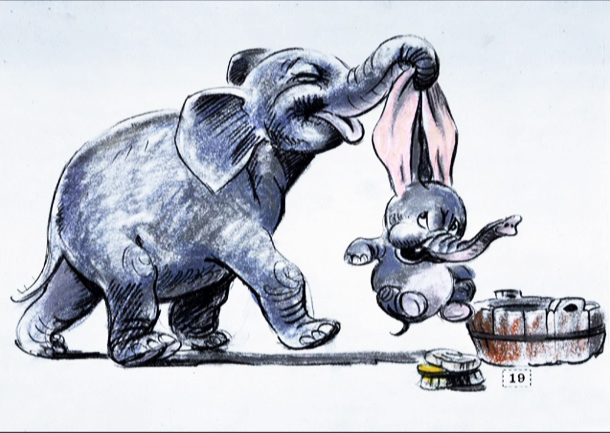
Bath time!

Carrying on where I left off, here is a sketch of Mrs Jumbo taking her son to be washed... everyone remembers this sequence in the film - a look at the loving relationship between mother and son before they are separated. Tytla's animation is a great portrayal of warmth and affection, of the way they are thoroughly happy to be in each other's presence. This sketch goes for a more comical approach: Dumbo is being taken to his bath against his will, a sulky, bratty expression on his face, while Mrs Jumbo's expression shows amusement at her son's ineffectual resistence. A perfectly valid depiction of a mother-son relationship, but hardly fitting for the only time we see them alone together. To me, Dumbo's expression makes him look too specifically to a drawing of a human boy in a children's storybook... in the film his appearance seems more universal, appealing on both human and animal levels.

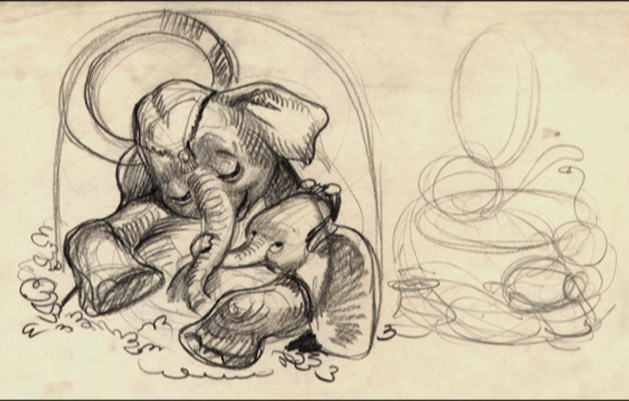
Mother and son

Speaking of humans, this pose for Mrs Jumbo and the way she holds Dumbo are much more anthropomorphic than the approach they finally settled on.

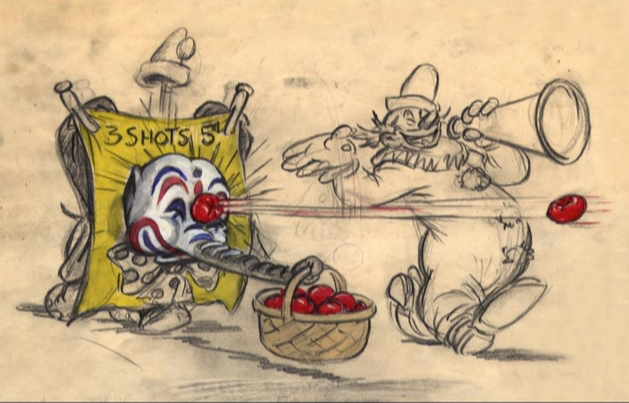
Whack-an-elephant

An unused example of the pain and humiliation Dumbo undergoes as a clown.

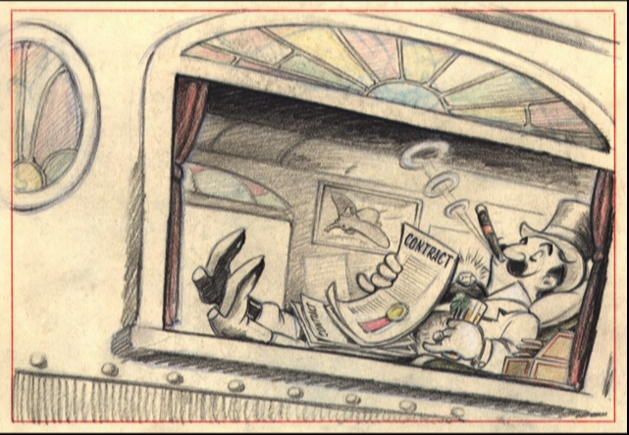
Wealthy Ringmaster

Now, in the film, the last we see of the Ringmaster is when Dumbo gets back at him during the Big Town sequence. In the following success montage, Timothy becomes Dumbo's manager, and is seen in a still, proudly signing a contract for him. All this is fitting: the Ringmaster was the one who separated Dumbo from his mother, while Timothy has been a loyal friend who we know can be trusted to look after Dumbo's interests. This sketch, however, shows the Ringmaster gaining from Dumbo's success - perhaps he was intended to be a more positive character than he eventually became.

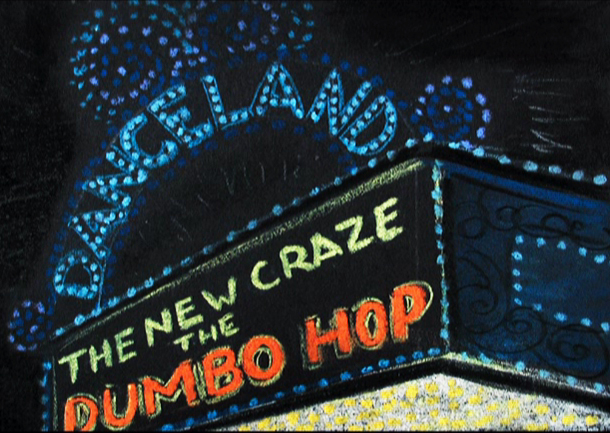
The Dumbo Hop

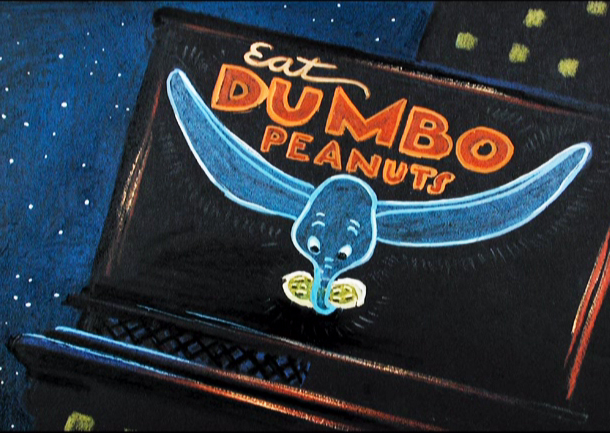
Dumbo Peanuts

Presumably the story department came up with various ideas for the success montage, and Walt Disney, Ben Sharpsteen or whoever chose which ones to include in the film. There are a few on the Splog which I wish had survived, as they show Dumbo entering the popular consciousness... I'm particularly fond of the "Dumbo Peanuts"... a bit more endearing than the implications of using Dumbo likenesses to bomb civilians in German cities...

Anyway, there are actually many more boards in Michael's post: these are only the ones which I felt I had something to say about. Once again, you can find the rest here. Until next time!

Sunday, 31 October 2010

Youse guise

Now, here is a song I wish I'd known about when I was a kid. I mean, I was familiar with the voice of Bing Crosby from Christmas records, and I was certainly familiar with Disney cartoons (see pretty much any post tagged "personal" and/or "kidhood")... and vaguely familiar with the concept of a headless horseman. But not quite as familiar as I would become...


From Ichabod and Mr Toad, the Disney package-feature with the non-chronological title. This is therefore from the second half of the film, and if you want to know who animated what in this sequence... well, you're in luck, because the draft can be found right here. By the way, anyone got any idea what "black or white or even red" refers to? The obvious answer is hair colours, but the use of "black" and "white" rather than, say "brown" and "blonde" makes it sound like they mean skin colours.

I did once dress as a headless ... man of some sort one Hallowe'en, and went around the neighbourhood with my younger sister, who was dressed as Casper the Friendly Ghost. I mean, she sang the Casper theme (transcribed by the whole family from a video, and containing one or two mondegreens), it's a shame I couldn't have sung something appropriate as well.

The costume included an over-large sweater, with a bow-tie around the top (to keep it from falling down and exposing my real, attached head... thereby destroying the illusion), and a papier-mache head with a wig on top and a gloomy expression painted on the face. It was a fairly last-minute idea and (Could have just used a pumpkin and saved myself the hassle... the shops would have been full of them, and being a traditional Scottish family, it's not like we'd have had any other use for one...)

No, there's no photos. Well, no digital ones anyway. If people are really interested, I could scan something. However, for the past decade or so, may Hallowe'en costumes have usually been variations on the following theme: "barbarian", "renegade knight", "warrior"... or, with some facial make-up, "orc", and rely on some handy pieces of sacking cloth, the fact that the majority of my clothes are black, and some arms and armour I picked up at a costume shop a while back.


Yeah, both of these photos are from the same year (for some reason they were all I could find), but they may as well not be.

Friday, 22 October 2010

In this post, I shall follow in the footsteps of Matt Groening

In the Simpsons comics, Matt Groening would often write some editorial (maybe he still does, I stopped getting them a few years ago... are they still running, actually, or is it all reprints? I mean, the ones I got were *already* reprints, of the American versions. Anyway...), sometimes related to The Simpsons but often just about his life. One of those was "Things which frightened and disturbed me as a kid." And that's kind of the approach I'd like to take to this post.

Sometimes it feels like my defining childhood moments involve watching something on TV which disturbed or haunted me. Usually they seem to be animated. There is one I remember which involved a ship which was overheating... the furnace was overloaded or something, and it was burning up. The main things I can remember are the scene where the characters escape by helicopter or something, and watch the ship blow up in a sort of mushroom cloud, and the fact that one of the characters had an unshaven face. If I saw it again I don't think it would have much of an effect on me, but at the time... well, let's just say I felt the need to leave the room any time The Simpsons was on - Homer's unshaven face brought back the unpleasant memory.

I'd love to find out what TV show that was, though.

Anyway, I think there can be something genuinely unsettling about the stark look of some of those 70s/80s animated TV shows, with their gloomy colours. One of them I am glad to say I was able to find. Say hello to... The Valley of the Dinosaurs, episode 5 "Volcano"!


Yes, it's only the second half. You're experiencing it the way I did. The first half isn't too hard to find if you're curious, and you want to know why this 70s family is hanging out with these cave-dwellers. Why these prehistoric Ama-zon inhabitants are white (or maybe slightly Asian) or why they speak in the same dialect as the 1970s family, only slower and with no inflections, remain mysteries.

So, anyway, this was a TV series that was on before Saturday morning Disney cartoons. So I invariably saw the last few minutes of it before the cartoons I wanted to see came on. This "Volcano" episode was being shown on the first morning I started seeing Saturday morning cartoons, and I must say that in spite of all the tackiness I see before me now, for a young kid like I was at the time, that volcano... referred to at 03:53 as "Devil's Pudding" for some reason... was High Octane Nightmare Fuel.

And, this was followed by an advert for some sort of superhero-based pasta shapes... which was animated, and involved a tidal wave of spaghetti sauce flooding through a city. I think I assumed this was the preview for the following week's episode: "Next time... the lava reaches the city and kills a lot of people!"

And then... the first cartoon on the Saturday Disney show was the Donald Duck classic "Good Scouts", where Donald and his nephews visit Yellowstone National Park... and begins with them all crossing a mud spring called "Devil's Stew Pot". Oh... and the fact that Donald later winds up on top of a geyser, which *erupts*, didn't exactly put the Hanna-Barbera Nightmare Fuel out of my head.

Friday, 8 October 2010

Dumboards - Part One

With Mark Mayerson's Dumbo mosaic drawing to a close I realised I should post my impressions on the story sketches Michael Sporn posted on his "splog" back in May. They're a really interesting look at some unused (or changed) ideas the story-men came up with.

Casey Jones Jr

First of all, Casey Jr, "slow asleep" as Jerry Colonna would have it, in his shed. Notice the full name "Casey Jones Jr" which never appears in the film. (I remember a Little Golden Book or something which referred to the loco as "Casey Jones" though) The name comes from the American legendary figure of Casey Jones, who would later inspire Jack Kinney's short "The Brave Engineer".

Dumbo, Mrs Jumbo, and "friends"

Here we have the other elephants surrounding Mrs Jumbo, with Dumbo resting at her back end. Human figures can be seen in the foreground, and the backdrop (with coconut palm trees) suggests an outdoor setting. The elephants are arranged in the same semi-circular position they are when they complain about Dumbo in the film, but their expressions appear to be kind and indulgent. I'm not sure if this is meant to be a version of Dumbo's birth/delivery, but he already has the big ears.

Toot-Toot-O!

Here we have Casey Jr (deliberately) scaring Dumbo and Timothy. Casey doesn't really behave in this manner in the film, where "he" doesn't do anything as humanised as his annoyed finger-drumming in his Reluctant Dragon segment.

Giant of the Jungle

Monarch of the Jungle


Now, these two are the big'uns. People have often wondered who Dumbo's father is. His mother is referred to as Mrs Jumbo, with a married woman's title, and Dumbo himself is originally named "Jumbo Jr." So, who is Jumbo Sr? The fact that Dumbo is delivered by a stork shows that, in this fantasy world, childbirth (and conception) doesn't really work the same way it does in our world, so we just generally assume he doesn't have, or need to have, a father.

But, these drawing suggest he was originally going to have one. Quite a famous one too, identified as "Jumbo, Giant of the Jungle", advertised on a poster for "...ingling Bros" circus. The elephants comment that Dumbo "belongs right alongside his daddy" and that "he'll be there soon". What does this mean? Are the other elephants encouraging him to go on to a greater circus? Was this before their personality/ies had been decided on? Or are they just wanting him out of their circus?

Following Pinocchio and with Bambi in production, it seems to fit the mold that Dumbo, as a young male protagonist, would have a father out there somewhere, if not by his side, and it seems that one of Dumbo's themes was, at one point, going to be about the little elephant trying to live up to his father's success. In the second sketch, look at the size of Jumbo Sr's ears! Were the storymen making these sketches even thinking there was to be anything "un-natural" about the size of Dumbo's own ears?

Keep watching this blog for more thoughts on these story sketches, and thanks to Michael Sporn for posting them up! I would be posting these as comments on his blog, if they were a bit shorter (and, if I hadnt waited until so long after he had posted them up in the first place...)

Thursday, 22 July 2010

Humans and animals in Friz Freleng's "Curtain Razor" (1949)

Friz (or "I.", of you will) Freleng's "Curtain Razor" was made around the time that Warner Brothers stopped populating their cartoons with humanoid "funny animals" and started using animated humans, except for series regulars like Bugs Bunny or Daffy Duck, or when the setting (e.g. a chicken farm) demands a certain type of animals (chickens, a guard dog, a fox or a weasel) as the main characters.

In this cartoon, Porky is a talent agent working for Goode and Korny, auditioning performers of various species.


Sometimes their species is an important part of the joke, sometimes it isn't. In the first category, we have a cricket or grasshopper with a loud, strong voice; a chicken who "lays an egg"; and a sheepdog with a flea circus. In the latter category we have the turtle with "a thousand voices"; the Crosby, Sinatra and Jolson birds; the goofy dog with the high-dive act... and, of course, the fox who blows himself up. We also have two humans... a two-headed guy who isn't in show business (he's the janitor) and "Cawford Coo" with his trained pigeons. Things get a bit blurred and confused: Porky thinks that the sheepdog (who walks on all fours, but enters by himself and speaks) is a "dog act" but doesn't assume the same of the high-diving bipedal dog in the bathing suit.

Contrast the two gags which Freleng would later re-use in 1957's "Show Biz Bugs. In the later cartoon, both the "Trained Pigeons" act and the "explosion" act were performed by Daffy Duck. But in "Curtain Razor", it was probably deliberate that one is performed by a human and one by a humanoid animal. It's probably better that "Crawford Coo" is a human, as the joke comes from the fact that the realistic pigeons behave just as real, untrained pigeons would (contrast the flea cricus in the same cartoon!) However, even though it isn't really important to the gag whether the guy who blows himself up is a fox or not, if the fox who blew himself up were human, it would probably be way too gruesome, and Freleng and his storymen may have decided that a gag like that should be left for imaginary beings like anthropomorphic animals, to keep it in the realm of the fantastic... no pun intended!

Wednesday, 30 June 2010

Dumbo Deleted Scenes - Part 4

OK, here we go... the rest of the deleted scenes. I can't claim that my reflections are completely comprehensive, so if any of you notice anything you feel I should have mentioned... either about any of these scenes or others I may have missed... then let me know in the comments!

As before, these are transcripts from the drafts - you can find scanned copies of the originals on the A. Film L.A. website by following the links in the scene titles. The portions of the transcript in italics are the parts which don't appear in the film, the rest is included to provide context.


Sequence 16: Clown Sequence (Draft No. 1)
____

1 LS - Tent. Clowns in sillhouette celebrating and singing, "WE'RE THE SMARTEST CLOWNS ----."

2 MS - Ollie and Frank dancing and singing, "WE'RE THE ANSWER TO AN OLD RINGMASTER'S DREAM."

3 MS - "WE'RE THROUGH WITH PLAYING HICK TOWNS, FROM NOW ON IT'S ---"

4 MS - Group of clowns dancing and singing finish of song - "---THE BIG TOWNS, FOR THE GREATEST CLOWNS THE WORLD

HAS EVER SEEN."


5 CU - Clown who says "HERE YOU ARE JOEY, POUR IT IN ME SLIPPER."
____

The dialogue throughout this sequence is not given in full in the draft, but in a shortened (and sometimes very slightly paraphrased) form. Fortunately most of the cut song is included in the draft, and, better yet, Hans has posted up an acetate recording of it, and of the "hit the big boss for a raise" reprise that survived into the film.

Mark Mayerson mentioned that a lot of the film relies on "the principle of contrast", and there's certainly a lot of contrast going from the tear-jerker previous sequence to the clowns laughing it up in their tent. There would have been more of a direct contrast if they had kept these scenes in, as the film would have gone from one song (the lullaby) to another (the clowns' celebration song). Maybe that kind of cut would have been a bit too jarring, though.

And, yes, two of the clowns are identified as "Ollie and Frank". If they really are named after the two animators Frank Thomas and Ollie Johnston, it's very interesting. Neither worked on Dumbo, but would have been occupied on Bambi at the same time. Seems like some light-hearted in-house rivalry. It's also interesting that, so soon after Ollie's promotion to full animator, than he and Frank would already have been seen as some kind of double-act.


Sequence 17: Hiccups and Cure (Draft No. 2) has quite a few differences in the draft, but not much in the way of deleted scenes. Scene 12 is a kind of deleted scene: after Dumbo has swallowed the alcohol-enhanced water, he lets out a hiccup, and the draft mentions a close-up of Timothy saying "OH, I GUESS YOU HAD ONE LITTLE ONE LEFT OVER." However, in the film he is off-screen when he says this.

Also, in scene 18, after Timothy emerges from the bucket, the draft has him say "GIGGLE WATER!", evidently in response to his own question about "WHAT KINDA WATER IS THIS ANYHOW?" The question is in the film but the answer isn't.

Mostly, though, we can see the opposite of deleted scenes - scenes which are in the film but not in the draft. I expect Mark Mayerson will cover this when he reaches this sequence in his mosaic.


Sequence 19.2 - Dumbo learns to fly (Final Draft)

Now, this one's a bit more complicated than the usual clean lifts. Thanks to Zartok-35 for first noticing it.
____

29 CU - Dumbo's head. Crows flying around. Timothy jumps out of Dumbo's hat on to his trunk. Crows Laughing.

30 EXTREME CU - Timothy on Dumbo's trunk talks to him, kisses feather. "DUMBO! I KNEW YOU COULD DO IT. NOW OUR TROUBLES ARE OVER. HO-HO!" To crows off-stage: "YOU BOYS KEEP THIS UNDER YOUR HATS. MUM'S DA WOID."

31 CU - Crows on top of Dumbo's head: "SHO' NUFF, BOY." "WE DON'T GONNA TALK." "NOT TO NOBODY." "MUM'S DE WOID."

32 CU - Two crows on top of Dumbo's head. Crow with deep voice: "MUM'S DE WOID."


33 CU - Timothy on Dumbo's trunk, says "WAIT'LL WE GET TO THE BIG TOWN."
____

As Zartok mentioned, a close-up of J.C. was added after this, saying "BOY, THEM CITY FOLKS IS SURE IN FOR A SU'PRISE!" This seems like a bit of a redundant addition: more something that would be taken out to condense dialogue (see story notes from The Reluctant Dragon) than added. In the next sequence, Timothy says basically the same thing - in both the draft and the film.

Or maybe they really needed to hammer it in that flying elephants are supposed to be surpising, in a world where storks literally deliver babies! Then again, we have just had a whole song about how unusual a flying elephant would be.

But a couple of other things, too. I'm not sure if I'd describe scene 29 as a close-up of Dumbo's head, also, it contains Timothy's "I knew you could do it!" line that the draft places in the next shot. I guess they didn't want to lose that line even though they were cutting the scene where it appeared. It seems a surprising number of differences for a so-called "Final" draft.


Sequence 20 - Big town, Dumbo triumphs (Draft No. 2)
____

3 LS - Burning building. Old Woman Clown running back and forth, yelling, "POOR BABY, OOH, OH."

4 CU - Old Lady Clown yelling, "SAVE MY CHE-ILD."

5 MS - Fire truck enters and throws clowns.

6 MS - Firemen land and run in confusion.

8.1 Clowns grab net - They all fall down.

9 Fireman cranks group of firemen up ladder.

10 Firemen on ladder come up into scene. Ladder out. Firemen fall out of scene.


18 MS - Four Firemen run in with net yelling: "JUMP, COME ON, JUMP."
____

It seems that originally this sequence was going to have a build-up to Dumbo's leap as big as the one in the earlier "Fireman Sace My Child" sequence, with several scenes of clowns fooling around as before. In addition to those actually included in the draft, there are also mentions of scenes 2, 7, 11, 12, 13, 14 and 16 as "No Scene" and 8, 15 and 17 as "Out of Picture". The difference in terminology might refer to different dates when these scenes were removed. At any rate, it appears that they gradually cut more and more of the build-up and eventually decided to just lose the whole thing and "cut to the chase".

Also, from the end of the sequence:
____

62 CU - Timothy in hat says, "THAT'S THE STUFF, NOW THE VERTICAL FLIP-FLOP."

51 LS - Dumbo weaves through tent poles and zooms out at upper left.

64.1 Dumbo's shadow on tent top. Timothy says,
"YOU'RE MAKING HISTORY!"
____

Now, as you can see, this is another more complicated cut -- it seems that the visual from scene 62 was used to end the sequence, but with Timothy's dialogue from scene 64.1. Also notice the numbering - quite a few shots in this sequence have been rearranged, as noted on the draft - similar to the "Fireman Save My Child" sequence. The draft we have is of the sequence as a work in progress, after they had started and before they had finished rearranging and removing scenes.

Well, that's it for deleted scenes. But the realms of "what could have been" extend further, with Michael Sporn posting some fascinating early storyboards on his blog last month, many of which are of unused story concepts. I'll take a closer look at them in a later post.

Sunday, 13 June 2010

Dumbo Deleted Scenes - Part 3

As before, these are transcriptions from the draft posted on Hans Perk's A. Film L.A. blog - material that was deleted from the film is put in italics, the rest is included for the sake of context.

Sequence 12: Gossips disown Dumbo (Draft No. 1)

This missing section includes a few more shots of the "gossip" elephants speculating about what happened to Dumbo after the Pyramid Act disaster. You'll also notice if you look at the draft that the sequence begins with scene 13, and the note: "Scenes 1 through 12 inclusive are out". Either the sequence was originally longer and the beginning was taken out before they even reached draft stage, or scenes 1-12 were an earlier version of the whole sequence, which was later discarded and replaced by the version described in the draft.
___

15 CU - Catty with block of ice on head - "OH, THAT WONT BE NECESSARY, DEARIE ... THEY'VE FIXED HIM GOOD!"

16 MCU - Matriarch and two elephants. Matriarch: "WHAT DID THEY DO?" Ella: "DID THEY BEAT HIM?"

17 CU - Prissy: "DID THEY THROW HIM IN THE... AH... CLINK?"

18 CU - Giggles (hopefully) "DID THEY SHOOT HIM?" (Giggles)

19 CU - Catty: "OH, A LOT WORSE THAN THAT, MY DEARS!"

20 CU - Matriarch. Catty, o.s.: Continues: "HE'D BE BETTER OFF DEAD."
Ad lib chatter: "GO ON, TELL US, TELL US!" Matriarch, angry: "I DEMAND TO KNOW!"

21 CU - Catty: "WELL, THEY'VE GONE AND.." She pushes ice back into place with trunk "..MADE HIM...OH DEAR, I JUST CAN'T SAY IT!" Matriarch, o.s.: "OUT WITH IT!" Catty "....MADE HIM A CLOWN!"
___

It's strange to hear one of the "gossip" elephants use Timothy's term "clink" ... don't they have their own term for it? (The Ringmaster was going to call it "jail" in the "Menagerie" sequence, but that line was also cut)

I'm not sure why these lines were taken out. Maybe the "ad lib" nature of the "chatter" meant that they were just never recorded? Was the gleeful "did they shoot him" deemed a little too harsh? Did they think that it would be more reasonable for Dumbo to have been shot or locked up, and they didn't want to call attention to the unusual nature of his punishment?


Sequence 14: Fireman save my child (Draft No. 1)

Scenes were taken out and shuffled around both before and after this first draft was typed up.
As we can see by the scene numbers as well as additional notes, scenes 2, 7, 14, 20 and 25 have already been taken out, and scene 12 has been moved to follow scene 22. Then, some time after the draft was written, scenes 18 and 21 were taken out, and 19 moved to between 16 and 17.
___

16 MS - Clown running in with sprinkler to flower box. Cocoanut [sic] tree springs out of flower box.

17 Two-shot. Big clown runs in with little clown who has barrel on back - takes out eye dropper and puts one drop of water on fire.

18 Two-shot. Old woman screaming - mouth wide open. Clown comes in with atomizer and sprays mouth.

19 LS - Firemen running up ladder to burning house and throwing water in Dumbo's face.

21 MS - Eskimo clown runs up to fire and warms [rear end].

22 MS - Dumbo in midst of smoke. Fireman climbs up and fans him.
___

With a bit of detective work we can also speculate that, before the draft was written, some scenes were added to give Dumbo more of a presence in this sequence, which otherwise might lose him amid all the clowning. A reaction shot of Dumbo is numbered 12.1, and scenes showing the effect of pouring gasoline on the fire, including another reaction shot of Dumbo, are 26.1 and 26.2. These numbers suggest these were late additions to the sequence. It may be that the rearranging of the other scenes was also to make sure that the audience didn't lose sight of Dumbo for two long at a time. I'm reminded of the Battle of Helm's Deep in the film version of The Lord of the Rings: The Two Towers, where they made sure that one of the main characters was on-screen for at least every third shot, so the audience had a focus.

As for the missing scenes themselves: I'm not sure who "old woman" in scene 18 refers to, although I guess it would have to be the clown dressed up as the elephant woman. Presumably "atomizer" means a breath freshener... I guess the gag was taken out because it's almost identical to scene 12 where a clown does the same thing with water from a flower, but a little less "clown-like." The "eskimo clown" from the deleted scene 21 doesn't appear at any other point in the sequence, and I'm curious as to what he would look like, and how late he was removed from the film. Then again, the "captain" from scene 12 doesn't seem to appear in any other shots either (notice the blue coat and epaulettes).

Friday, 4 June 2010

Dumbo Deleted Scenes - Part 2

It occurs to me I should have listed what the draft number has been for each sequence. I have therefore edited the previous posts to include this information.

Sequence 10: Ringmaster's Idea for Pyramid Act (Draft No. 2)
___

1 MLS - truck to MCU - Shadows of Ringmaster and Joe appear against side of tent. Ringmaster says: "WHAT AN IDEA! YOU KNOW, SOMETIMES I WONDER WHAT MAKES ME..."

3 MCU - Tim and Dumbo watching Ringmaster. o.s. Ringmaster: "SO SMART!" Tim talks over his shoulder to Dumbo: "HUH! HE NEVER HAD AN IDEA IN HIS LIFE -" Ringmaster continues: "JUST VISUALISE..."

4 MCU - Shadows of Ringmaster and Joe. Ringmaster tosses coat - Joe catches it. Ringmaster, excited, continues: "IN THE RING STAND SEVENTEEN ELEPHANTS!"

4.1 MCU - Shadow of Joe - "hangs up" coat, missing pet [?] and allowing coat to fall on floor. Ringmaster o.s. continues "ONE ELEPHANT CLIMBS ON TOP OF ANOTHER ELEPHANT UNTIL..."

5 CU - Ringmaster wriggles out of pants, kicks them up in the air and catches them, as he says: "...FINALLY ALL SEVENTEEN ELEPHANTS HAVE CONSTRUCTED AN ENORMOUS PYRAMID..."

6 CU - Joe's shadow. Ringmaster, o.s., continues "...OF PACHYDERMS!" Joe, puzzled, scratches his head - asks: "WHAT'S A PACHYDERM, BOSS?"

7 MCU - Shadow of Ringmaster - Tosses pants to Joe, o.s., as he says "THAT'S AN ELEPHANT, STUPID. HANG UP MY PANTS!"

8 CU - Joe's shadow - He catches pants, hangs them up as he says "GEE, BOSS, I DON'T KNOW HOW YOU THINK 'EM UP!" Ringmaster, o.s.: "THAT'S NOTHING!"


11 CU - Shadow of Ringmaster wriggling into nightshirt - continues: "THERE STANDS THE PYRAMID OF ELEPHANTS..." Arms shoot up thru sleeves - "I STEP OUT!" Head pops thru neck of shirt - "I BLOW THE WHISTLE!"

12 CU - Tim on tent-peg - Ringmaster continues... "THE TRUMPETERS ARE TRUMPETING - THE DRUMS ARE DRUMMING -" Tim stands up to listen. Ringmaster, o.s., very excited continues "...AND NOW..."

14 MCU - Shadows of Joe and Ringmaster. Ringmaster continues: "...COMES THE CLIMAX!" Joe: "YEAH... WHAT IS THE CLIMAX?" Ringmaster: "I DON'T KNOW"

16 CU - Tim. Ringmaster, o.s. "...DOT'S CHUST VOT I DON'T KNOW." Tim relaxes into disappointed expression - says: "I KNEW HE NEVER HAD NOTHIN' ... BUT STILL I WAS HOPIN'."

17 MCU - Shadow of Ringmaster - "WELL, MAYBE IT COMES TO ME IN A VISION WHILE I DREAM. GOODNIGHT, JOE." Climbs into bed. Joe, o.s. "GOODNIGHT, BOSS."
___

The main thing from this draft section that isn't in the final film is the Ringmaster explaining to Joe what a pachyderm is. I'm glad they took this out - it just feels like the storymen are calling attention to the fact that they know a word which they think the "average Joe" doesn't. Anyway, we already know that the Ringmaster is talking about a pyramid of elephants, so the audience should know what he means, even if they've never heard the word "pachyderm" before. I do think that the Ringmaster ordering Joe to hang up his clothes is funny though, just after insulting him.

Notice that one of the Ringmaster's deleted lines is written in a thicker German accent than the rest of the dialogue. I'm not sure why that is, although even in the final film he starts to sound more Germanic as he falls asleep.

Also noteworthy is that Timothy's line about "hopin'" the Ringmaster had an idea was cut. I'm not sure why he would hope this: it hasn't occured to him yet that this could be Dumbo's chance to shine. I guess Timothy himself sort of makes a living from the circus and wants it to be successful.

Notice that although the film does not retain the Ringmaster's full description of the pyramid act, he still says "seventeen" elephants will perform rather than the seven who do (or eight in the opening shot, for some reason).


Sequence 11: Pyramid Act
(Draft No. 3)

Not really a deleted scene, but an alternative version of a line, at the start where the Ringmaster is announcing his act.

___

3.2 CU - Rearview of Ringmaster: ...PYRAMID OF PROUD, PONDEROUS, PULSATING.....

3.3 CU - Ringmaster:...PULCHRITUDINOUS PACHY. PACHY.....I GIVE YOU THE ELEPHANTS!

___

It appears that the Ringmaster struggles over the word "pachyderm" and gives up. In the film he has no such problem with the word. Once again, the film differs from the draft in that it does not make such a big deal about the word "pachyderm" - the film-makers aren't trying to call attention to their vocabulary.