Load your counters in. Then, begin! Tug at the wheels to get all your counters down to the trays at the bottom as quickly as possible, at the same time as your opponent is doing the same thing. Use brute strength to move the wheels the way *you* want them to move, while your opponent uses brute strength to do the same thing. And hurry up!
Yes, the link above says that you should take turns to move the wheels, and that's how parents and friends' parents told me I was supposed to play it, but I was unconvinced. For one thing, it didn't seem as much fun as my version. Also, the blurb on the box seemed to support my way of playing the game: it described it as a "strategy" game, and "strategy" quite obviously meant tugging at wheels trying to outdo your opponent. I guess I didn't really know what the word meant, and I was relying on the sound of the word - the "str" beginning must have sounded like "strength", "struggle" and "strain" to me.
That, and that's what I'd have *liked* it to mean.
From Bob Clampett's "The Bashful Buzzard" (1945) You won't like this dragon when he's angry. Not only does he suddenly grow himself some teeth, but his head changes shape and size! It's not like we actually see his head changing on-screen... but Beaky Buzzard doesn't recognise the "mean" face when the dragon starts growling at him (0:58-1:08), so we have to assume either a) the dragon's head changed off-screen or b) Clampett assumed his audience would forget that they and Beaky had seen the "turtle" face a few seconds ago. (0:25-0:45)
By the way, anyone know where those "bringing home a baby bumblebee" lyrics orginated? Apparently there's a girl guides / girl scouts song with the same tune and the same lyrics, followed by "I'm squishing up / licking up / bringing (or barfing) up / sweeping up my baby bumblebee"... I wonder if this version predates or postdates Clampett's use here.
I saw the Animaniacs segment "Bumbie's Mom" about 17 years ago. The plot is this: curmudgeonly veteran cartoon star Slappy Squirrel and her peppy nephew Skippy are watching the film "Bumbie, the Dearest Deer" (as you can imagine, it's a Bambi parody) and Skippy is traumatised by the mother's death. To cheer him up, Slappy takes Skippy to visit Vina Waleen, the deer woman who played the mother in the film.
Strangely enough, I only saw Bambi for the first time a couple of years ago - I had only known about it through osmosis before. It's interesting to compare the familiar parody with the unfamiliar original.
Specifically, the way the action is compressed. In the Animaniacs episode, the mother warns Bumbie that there is "no cover from the hunters" on the meadow, then, soon after, we hear a gunshot and Bumbie asks plaintively for his mother. (Cue Skippy bursting into tears) This is followed by the forest fire sequence, and Bumbie, still a fawn, calls again for his mother amid the burning trees.
That brief scene encapsulates what people remember about Bambi: Bambi is a baby deer, whose mother is shot by hunters, and there is a terrifying forest fire near the end. It was interesting, when finally seeing the film, to notice how much of a compression this is.
The part where Bambi's mother warns him about the hunters on the meadow comes long before she is shot by one... in fact, it's a completely different time of year. And, while the forest fire does follow from scenes where animals are in danger from hunters, it is even later... by which time Bambi is fully grown! He is also not still looking for his mother... in fact, I don't think his mother is even mentioned after the Prince (Bambi's father) tells him "Your mother can no longer be with you."
So, we have an amalgamation of three points in the film, separated by months or even years... concentrated into that one brief scene.
First of all, I'm not sure when he added this, but thank you to Michael Sporn for adding a link to my blog on his "Splog"! Now, it's high time I returned to the Dumbo storyboards he posted up several months ago.
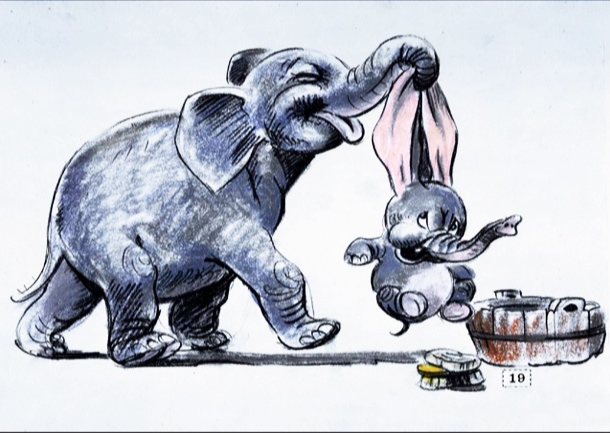
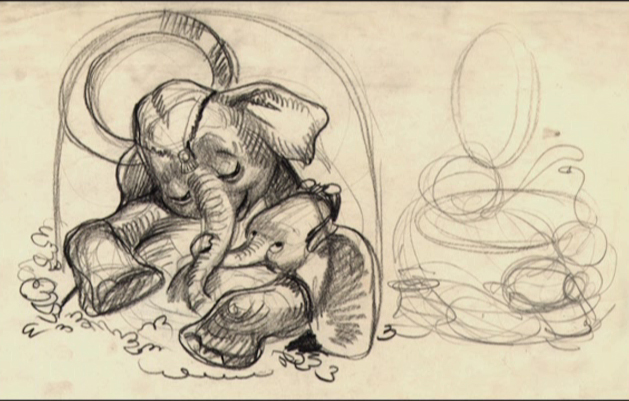
Carrying on where I left off, here is a sketch of Mrs Jumbo taking her son to be washed... everyone remembers this sequence in the film - a look at the loving relationship between mother and son before they are separated. Tytla's animation is a great portrayal of warmth and affection, of the way they are thoroughly happy to be in each other's presence. This sketch goes for a more comical approach: Dumbo is being taken to his bath against his will, a sulky, bratty expression on his face, while Mrs Jumbo's expression shows amusement at her son's ineffectual resistence. A perfectly valid depiction of a mother-son relationship, but hardly fitting for the only time we see them alone together. To me, Dumbo's expression makes him look too specifically to a drawing of a human boy in a children's storybook... in the film his appearance seems more universal, appealing on both human and animal levels.
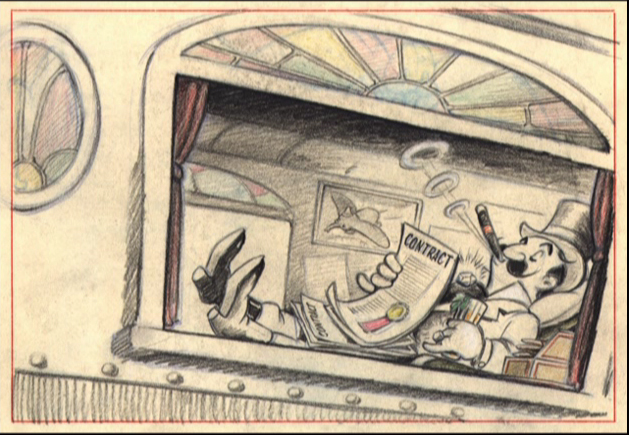
Now, in the film, the last we see of the Ringmaster is when Dumbo gets back at him during the Big Town sequence. In the following success montage, Timothy becomes Dumbo's manager, and is seen in a still, proudly signing a contract for him. All this is fitting: the Ringmaster was the one who separated Dumbo from his mother, while Timothy has been a loyal friend who we know can be trusted to look after Dumbo's interests. This sketch, however, shows the Ringmaster gaining from Dumbo's success - perhaps he was intended to be a more positive character than he eventually became.
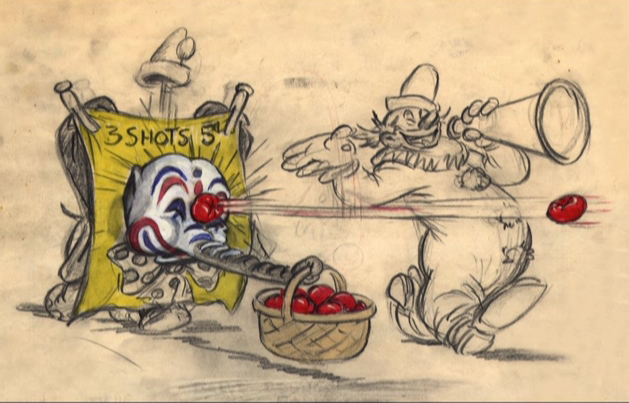
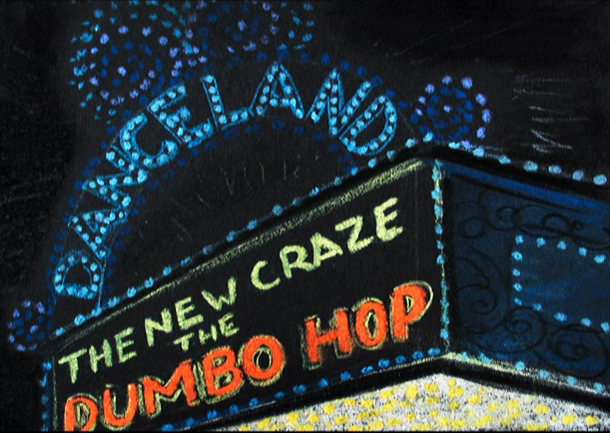
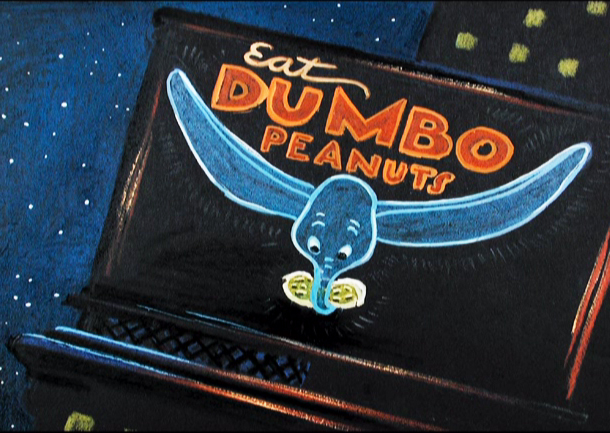
Presumably the story department came up with various ideas for the success montage, and Walt Disney, Ben Sharpsteen or whoever chose which ones to include in the film. There are a few on the Splog which I wish had survived, as they show Dumbo entering the popular consciousness... I'm particularly fond of the "Dumbo Peanuts"... a bit more endearing than the implications of using Dumbo likenesses to bomb civilians in German cities...
Anyway, there are actually many more boards in Michael's post: these are only the ones which I felt I had something to say about. Once again, you can find the rest here. Until next time!
Now, here is a song I wish I'd known about when I was a kid. I mean, I was familiar with the voice of Bing Crosby from Christmas records, and I was certainly familiar with Disney cartoons (see pretty much any post tagged "personal" and/or "kidhood")... and vaguely familiar with the concept of a headless horseman. But not quite as familiar as I would become...
From Ichabod and Mr Toad, the Disney package-feature with the non-chronological title. This is therefore from the second half of the film, and if you want to know who animated what in this sequence... well, you're in luck, because the draft can be found right here. By the way, anyone got any idea what "black or white or even red" refers to? The obvious answer is hair colours, but the use of "black" and "white" rather than, say "brown" and "blonde" makes it sound like they mean skin colours.
I did once dress as a headless ... man of some sort one Hallowe'en, and went around the neighbourhood with my younger sister, who was dressed as Casper the Friendly Ghost. I mean, she sang the Casper theme (transcribed by the whole family from a video, and containing one or two mondegreens), it's a shame I couldn't have sung something appropriate as well.
The costume included an over-large sweater, with a bow-tie around the top (to keep it from falling down and exposing my real, attached head... thereby destroying the illusion), and a papier-mache head with a wig on top and a gloomy expression painted on the face. It was a fairly last-minute idea and (Could have just used a pumpkin and saved myself the hassle... the shops would have been full of them, and being a traditional Scottish family, it's not like we'd have had any other use for one...)
No, there's no photos. Well, no digital ones anyway. If people are really interested, I could scan something. However, for the past decade or so, may Hallowe'en costumes have usually been variations on the following theme: "barbarian", "renegade knight", "warrior"... or, with some facial make-up, "orc", and rely on some handy pieces of sacking cloth, the fact that the majority of my clothes are black, and some arms and armour I picked up at a costume shop a while back.
Yeah, both of these photos are from the same year (for some reason they were all I could find), but they may as well not be.